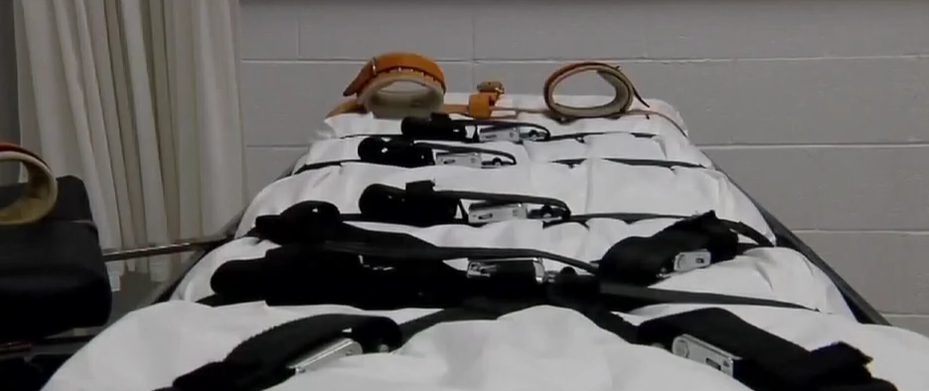
NASHVILLE, TN (WOKI / WVLT) – Court filings revealed Wednesday that attorneys for Tennessee death row inmate Christa Pike warned state officials months before her failed execution that Tennessee’s revised lethal injection protocol contained serious shortcomings and lacked critical details.
The issue surfaced during a Nashville court hearing where Pike’s attorneys sought preservation of evidence connected to the Sept. 30 execution attempt.
According to Pike’s legal team, concerns were formally raised in a more than 350-page complaint filed in Davidson County Chancery Court earlier this year. Attorneys argued that Tennessee’s revised execution protocol, reduced from 106 pages to 44 pages, failed to adequately address problems identified during previous reviews of the state’s execution procedures.
Pike survived Tennessee’s Sept. 30 execution attempt after prison officials administered two doses of pentobarbital, the drug used in the state’s single-drug lethal injection protocol.
Instead of dying, Pike remained alive and was rushed from Riverbend Maximum Security Institution to a Nashville hospital. She spent several days unconscious and on a ventilator before regaining consciousness on Oct. 6.
During Wednesday’s court hearing, defense attorney Luke Ihnen referenced the January complaint, arguing that many of the concerns raised before the execution now appear especially relevant.
The filing challenges changes announced by the Tennessee Department of Correction in late 2024 after an independent review of the failed 2022 execution attempt involving inmate Oscar Franklin Smith. That review concluded that the department had operated in a “task-oriented” manner and failed to fully account for the interconnected nature of the execution process.
According to Pike’s attorneys, the new protocol did not correct those deficiencies. Instead, they argued it eliminated detail and transparency regarding critical aspects of the execution process.
Among the concerns raised was the lack of information regarding how pentobarbital is obtained, whether it is compounded or manufactured, and what quality-control measures are used to test the drug before executions.
Defense attorneys argued that the state provided only general references to quality assurance procedures without revealing specific testing standards or regulatory requirements.
The failed execution has also highlighted a potential gap in Tennessee’s protocol.
The current procedure outlines steps to follow once the primary and backup syringes have been administered. However, the document reportedly does not specify what should occur if an inmate remains alive after receiving both doses.
Following Pike’s execution attempt, Tennessee Department of Correction officials stated that the protocol did not authorize additional procedures beyond those already performed.
Witnesses reported Pike exhibited labored breathing after the injections, including sounds described as snoring and choking. She was later transported to a hospital, where she remained on a ventilator for nearly a week.
The case has prompted significant legal and political fallout across Tennessee.
Governor Bill Lee suspended the state’s remaining executions for 2026 and ordered an independent third-party review of the execution process. A Nashville judge has also ordered the preservation of all evidence connected to Pike’s execution attempt, including drugs, syringes, IV equipment, logs, recordings and related documentation.
Pike remains hospitalized as questions continue surrounding her medical condition, the effectiveness of Tennessee’s execution procedures and whether the state may attempt to carry out her sentence again in the future.
Pike was sentenced to death for the 1995 torture and murder of fellow Job Corps student Colleen Slemmer, a crime that remains one of Tennessee’s most notorious murder cases.
Key Developments
- Pike’s attorneys warned in January that Tennessee’s revised execution protocol was vague and incomplete.
- The protocol was reduced from 106 pages to 44 pages.
- Pike survived a Sept. 30 execution attempt after receiving two doses of pentobarbital.
- Defense attorneys questioned the state’s drug sourcing and quality-control procedures.
- Court filings argue the protocol failed to address known concerns identified after previous execution problems.
- Governor Bill Lee has paused remaining Tennessee executions for 2026.
- A judge has ordered preservation of all evidence related to Pike’s failed execution.
- Investigations and legal challenges remain ongoing.